Przepraszamy, niestety ta strona nie jest jeszcze dostępna w języku polskim.
My experience of going to Ende Gelände with Reclaim the Future
…will i get beaten by the cops? Will I get stuck in prison, get banned from Germany, or end up with a massive fine? There was this general feeling of not being prepared. At the same time, I knew it’s something I want to do. I wanted to know what a mass action actually feels like. And recently, I had thought a lot about what it means to be in a global race against time, regarding climate change. After all, so many previous attempts have been fruitless, despite unquestionable bravery and hard work, so I ask myself the question whether the climate movement is using the right tools, the right strategies? Are there even any viable strategies at hand? I was hoping that, what I couldn’t find answers for in endless books and logical arguments, might be revealed to me in the bodily experience of “being there”.
On the bus to Germany: good vibes and new acquaintances, interspersed with discussions about border passage, ID’s, and what someone might consider suspicious luggage. News reached us that a french bus had been stopped and one activist denied entry at the border. When changing to the ferry, we were supposed to dress plainly. This was fascinating – to see such coloful and expressionate people don hoodies and baseball caps. But we reached our goal without a problem.
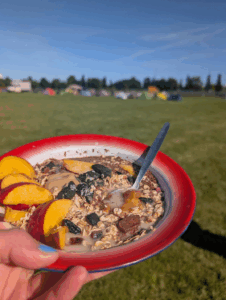
Hammer Klimacamp, an enourmous campsite established in a large park in the city of Hamm, an hour or so from Dortmund, Germany. We arrived 7:30 in the morning, pitched our tents along thousands of others, and started gathering information – when do different programme points start? Who do you talk to? Where do we find food? Should we stay together as a group or move about more freely on our own? And most importantly, when do we find out anything about the actions?
The first day felt like an eternity. So many impressions! So much information! And a culture shock – the germans are way more autonomous and self-organized as participants. You are expected to just know quite a few things, and manage on your own to a large extent. If you miss an info briefing, it’s on you to ask around
and try to puzzle it together. Oh, two briefings are scheduled in parallell? Then you’re expected to send delegates from your group to both if you’re interested, and preferably also have the rest of your group help with the dishes, because hey, that’s needed too. I realized we’re used to getting things served to us in a neater package, we’re used to a little bit more handholding in Sweden. It took our group some time and emotional energy to get over that. But we didn’t give up, we supported each other, kept track of how each of us was feeling, our needs, and tried to handle all the frustration and tiredness as well as we could. In the many unexpected situations, several of us stepped forward and showed leadership by taking on responsibility in practical matters. I was happy to be in good company.
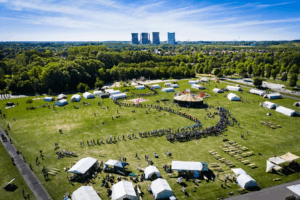
Ende Gelände is a mass action employing a “finger” tactic, which means several actions are carried out simultaneously. The goal is to disrupt the operation of fossil fuel infrastrucuture, to signal that it needs to go away. Ende Gelände is also an evolving initiative – as I understand it, a few years ago the climate movement used to be laser focused on emissions of CO2, refusing to want to speak about injustice, about Palestine, just trying to “keep the message focused”. In contrast, this year’s Ende Gelände was saturated with connections across topics and geographies. There was a multitude of workshops and slogans on militarization, imperialism, technocracy, landgrabbing, and many other interconnected struggles.
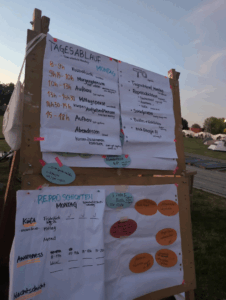
Information was announced during so-called “plenums” – large gatherings in the circus tent in the middle of the camp. This was information such as how many volunteers are still needed for cleaning the makeshift toilets, or that a thunderstorm is approaching in three hours. And most important – what actions one could sign up for. We got very little information about the actions, just the bare
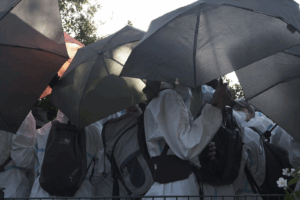
neccessities, and for good reason – with a half dozen police cars parked right outside the camp grounds, it wasn’t hard to imagine that police would also try to infiltrate our meetings. Another contrast to my experiences in Sweden: the masking culture. Many participants kept their faces covered all or most of the time, especially when moving outdoors, and especially those in some leadership roles.
Again, the explanation was simple – the police are constantly looking for someone to point out as a leader, in order to send repression their way.
We considered which action to join. Many of us were worried about missing the bus back home. The many conversations, and practical preparations such as refilling water bottles across camp, or packing the action bag, dragged out in time, and added to the general atmosphere of lack of sleep. Once again we had to practice prioritizing, deciding which problems need to be solved now, which ones can wait, and balancing regard for others’ needs with one’s own limitations.
The night before the action I left my ID card with a friend who was staying at camp, with improvised instructions on what should be done should I get detained for longer. In the last moment, I was still messaging friends and family, preparing them for that worst case scenario, and trying to improvize a plan for what should happen to my luggage. I wish I had planned this better ahead of time, the extra stress was unnecessary there and then. With nerves on full alert and a quick prayer, I finally huddled up in my sleeping bag and tried to get to sleep.
On the day of the action: early wake-up, it’s on now. Preparation anxiety gave way to focused execution. Get the right bag. Find my partner. Follow the instructions to get to the location. The way was long, and we passed several police patrols on the way, but they did not bother us. We spoke about all sorts of things on the way, for some reason, we spoke a lot about religion and churches. Finally we reached the gathering spot. A big bus. We greeted other activists, and thought we were ready for departure… and then, first one, then several police cars started showing up. The
bus was prevented from starting. The cops talked to the driver, they stood there in full gear and were watching us, not allowing us to leave. Nobody knew anything – least of all on which legal basis a random bus can be kept like that. Two or thee hours passed. We kept our spirits up by playing games, chanting, talking. Some germans tried reasoning with the police. The police were “just following orders from above”.
In that bus, we had ongoing discussions on how to proceed through the process of “delegate plenaries”, where each group sent one representative to debate options for next steps. What should we tell the cops? What should we try to do? Us being from Sweden, we didn’t know the local context and felt that perhaps it was a bit hard to contribute constructively.
It was boring to be stuck in a bus. It wasn’t what we had hoped for. One ray of hope that reached us was that the police really seemed to have piled up on our “finger” – there was at least six police vehicles around us now. That’s six police vehicles distracted from the other fingers, who according to our info, were still moving freely.
Finally, the germans managed to get the police to let us drive – but only to a specified target location – and our bus left the parking area, escorted by police. We saw four cop cars before us, another four behind us. I joked that this was more than Iran’s exile prince had had in Sweden on his recent visit.
On the long way there, we cheered as a piece of positive news reached us – multiple other groups had achieved their targets! Occupations of a gas pipeline factory, and a military steel company, had been established. Our boredom had contributed to their success.
Then, out on some country road, the police forced our bus to stop. What’s going on? Cops started lining up outside our doors. “They’re going to enter! They’re filming!” someone called out. In an instant, all the draperies were pulled closed and masks went on. The masking culture has multiple purposes, one of which is to protect people extra vulnerable to repression, such as BIPOC people or those with migrant status. Some people were asking what right they have to board a private bus? Everyone was tensely wondering, what is going to happen. We noticed a press photographer on the other side of the street. Someone spoke of an observer from parliament. I would later learn that german police has a few toxic tendencies – they can allegedly want to “show how hard they can go on us” among each other. Hierarchical oversight, such as a member of parliament being present, can reduce the risk of the cops stepping outside their legal rights. Here, we were again stuck for a long while of uncertainty – would the police board our bus? Would we try to escape? Should we bargain with them?
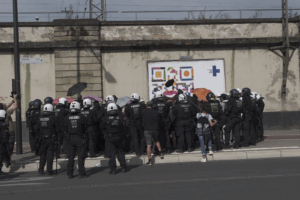
They never boarded, and we didn’t leave. The day ended, after many sweaty hours in buses, with us driving back to camp. Once there, tired and in low spirits, we took care of our basic needs and informed friends and family that we were OK. We kept waiting for news of the other fingers who had managed to reach their targets. There was a thunderstorm, a proper one, we had to seek shelter and make sure our tents didn’t blow away. We would later find out that in that same moment, the pipeline group was being removed by police who had kept them in boiling sun, and now thunderstorm, outside for several hours. We in the bus group decided to attempt an action again the next day. Some of our friends returned, some were presumably still being held as we went to sleep.
Saturday morning. Organized chaos. We wanted to surprise the police by materializing a huge column of activists out of nowhere. We gathered in stealth, then rushed towards our goal. The police were on us, I saw a cop join our running column and repeatedly body tackle a female activist in the row before me. We might have been succesful in overwhelming them, but something went wrong at the front of the column – no one knew what – only that the hand sign for “stop, medical accident” had been made and so the whole column made a halt. The police of course used the extra time to drive multiple vehicles before and after us, blocking us in place, and the rest of the day became yet another anticlimax of being led around by police escort. They “permitted us to walk our demonstration”, constantly surrounded by them “for our safety”. I abstain from going into more detail about that day.
Here, I feel that I have to say something about illegal actions. Should one not follow the law? Does not the police act rightly when stopping us? Does not the owner of the gas terminal have a right to his profits? It is detestable when we can’t tell law from morals. We are too blind to see the power relations that generate our surrounding reality. That way, proportions are distorted, and “might makes right” starts to look like just “right”. The current order, with a fossil fuel industry concentrating advantages and wealth with the world’s richest, and at the same time dumping poison, hurricanes, famine and drought on everyone else, that order is what the police is defending. Ask yourself, who decides what laws are written? How large is the influence of the richest on both the letter and the implementation of the law? No, the more I pay attention to what’s happening in the world, the less respect I have for legislature, as it seems to me only to serve the purposes of the
powerful, rather than being “rules for living well together in a society”. Which is funny, because I’m an extremely law-abiding person by nature. I like there to be order and rules, to make sure everything works out well. But I recognize mobbing when I see it, and a lot of legislature is currently nothing more than a bully’s weapon.
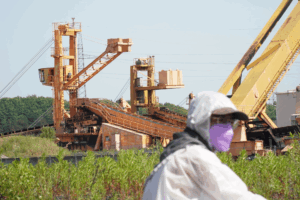
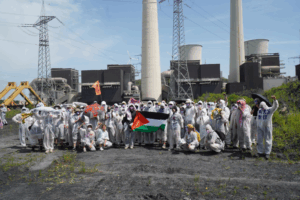
Back to the second action day, it’s enough to say that everyone returned home unharmed, and those being held from the last day finally got released. We took the time to debrief, to speak about our experiences, both those of us stuck in buses and those occupying train tracks. The camp as a whole also had a festive debriefing, during which we got to see pictures and clips being published on social media. We got to see news reactions, how the public debate was taking shape. If I felt
dejected before, this helped lift my spirits – seeing other actions that had been successful set my experience in a new color. I was happy that I had contributed to all this.
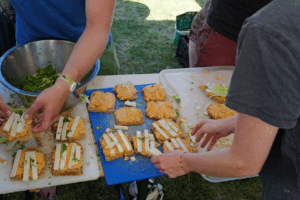
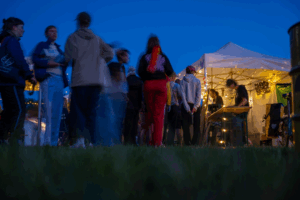
I don’t want to forget to write about the atmosphere at camp, which was truly magical. An incredible, positive feeling of solidarity, responsibility, and the struggle for a better world. People contributed with beauty, music, soap bubbles, and pretty colors. One tent kept serving crêpes backed by the best lounge-jazz music imaginable. Dishwashing to top-tier german techno. The vegan food was delicious, and there were many skillshare-workshops, musical presentations, and people witnessing of their experiences from around the world. The last day ended with an epicdance party far into the night. It will be long until I forget the camp as a place, as a way of being. The atmosphere carried a lot of people’s longing for another society.
After the actions: recovery, preparations for the journey home, helping to deconstruct the camp over the next two days, and of course taking contact details and making new friends. I signed up for two night security shifts – patrolling in pairs with a walkie-talkie, just to keep an eye on unusual visitors. This was very rewarding, to be able to have an hours long conversation with the same person.So what came out of this? Did I get any new revelation regarding the climate struggle? I still feel full or doubts and confusion, but I can name a few new insights which I do take with me.
First – the masking culture, the anonymity, the cybersecurity practices. I’ve seen very little of this, if any, in Sweden. While we do everything “openly and honestly”, the germans take pragmatic steps to limit the repression they receive day by day. I think they’ve experienced repression more harshly than we have. It’s the experience of realizing that your climate engagement is in opposition to the interests of those in power. When you actually threaten the ruling order, it will try to destroy you. I think many of us in Sweden still don’t realize this, we are so used to “everything is nice here and people are kind”. And it is a different context, differences should be expected. But it’s a look forward to how a continued climate struggle might look like, as democracy is continuously taken down and weakened. Just recently, the Swedish government voted to make it possible to encroach on the right to assembly. My personal takeaway? I’ve got work to do regarding raising the bar of cybersecurity in the swedish climate movement.
Second: transnational solidarity in practice. When countries compete with each other, it will always be in their interest to destroy the planet. According to the authors of the book “All in”, a climate struggle only addressing a single nation’s politics is doomed from the outset. A global power struggle must somehow form. The authors present a heuristic that 3/4 of a given movement’s strategy should be informed by international needs. This Ende Gelände was certainly going in that direction.
Further – I experienced how there’s struggle going on everywhere at once. Personally as an activist, and perhaps in the swedish climate movement as a whole, we can tend to have a “Messiah-complex” of sorts, a belief that we are the chosen ones to start a movement which will somehow save the whole world. In the worst case this makes us naive and puts an impossible burden on our shoulders. But I understand why I and others think this way – it’s really hard to let go of the thought that the future we believed in somehow can be saved. To place one’s hopes in a supposed common effort among the peoples of the world, to which we have to contribute, rather than within one’s own sphere of influnence, that is something difficult and new that I’m still adapting to. But it rings true.
I also think of inclusivity, on different levels. The camp had interpreters on the large briefings – people who translated what was said in german in real time, into small receivers one could pick up. There were many other examples of adaptations, to enable more people to take part. The masking culture itself is another clear example of inclusivity. There is often talk of the climate movement being white. Something that isn’t always said is that, we go straight into the police’s open arms and expect to be treated professionally. But not everyone can have that expectation, for various reasons, such as having experienced police violence and unfair treatment firsthand. So maybe we should reconsider our friendly relationship with the police, in the light of the experiences of others, maybe we could find more ways to let those speak, who can’t take the increasing repression that is being handed out. But also, maybe we can do better in therms of accessibility in language, in physical barriers, or information sharing.
I think this is most of what I had in my head. Damn, this was scary! But it only gets worse as long as we sit quietly and let the most powerful exploit us. During the actions, we had affinity groups, and we grew deep bonds of trust and care. We need each other in the daily life as well, others who see injustice and want to be part of fighting against it.